

Pick a socket
A maker that also trades as a taker opens two connections, one per key. Server integrations price from
their own Hyperliquid feed and read the market catalog over
List markets. The market data socket is for apps.
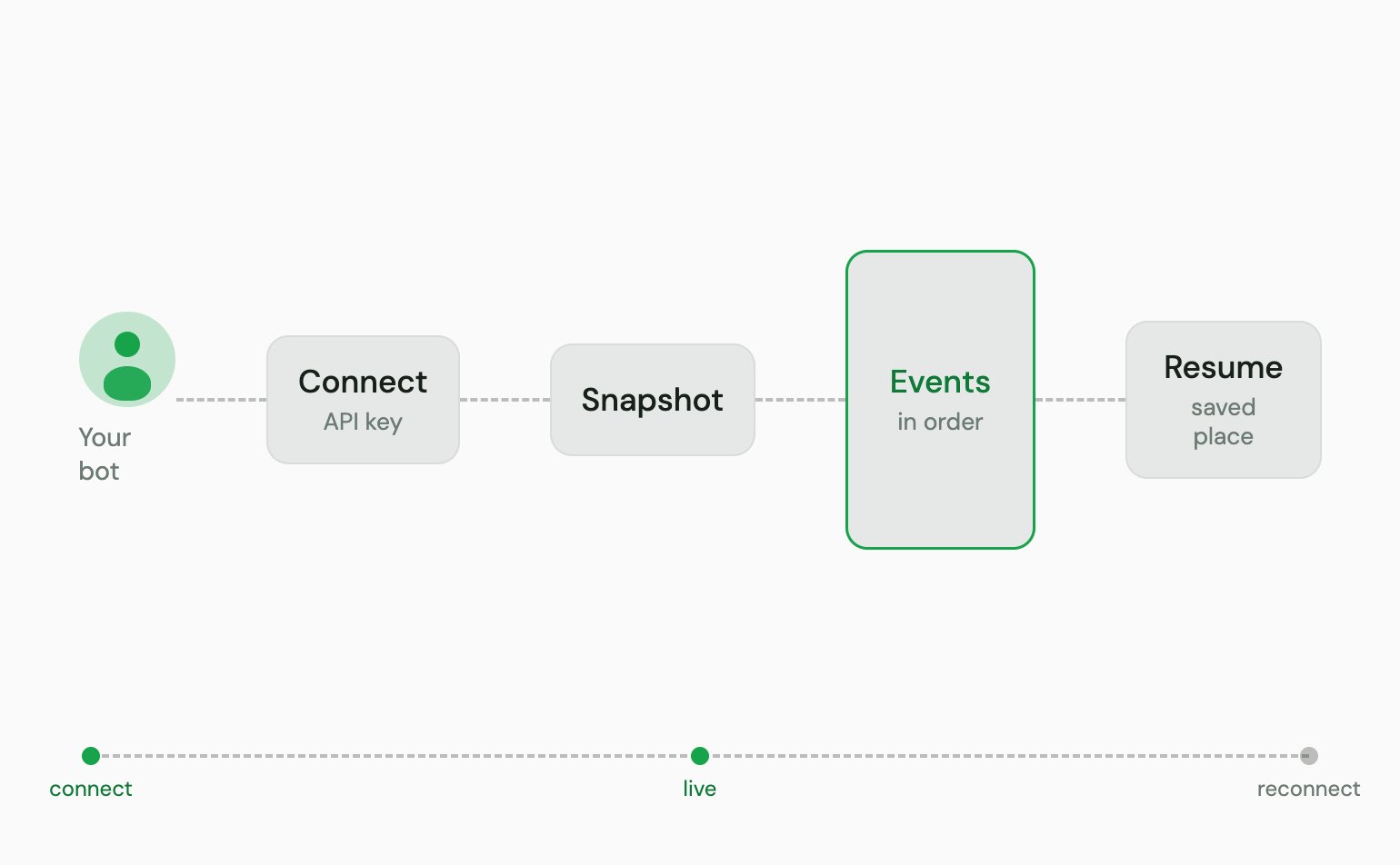
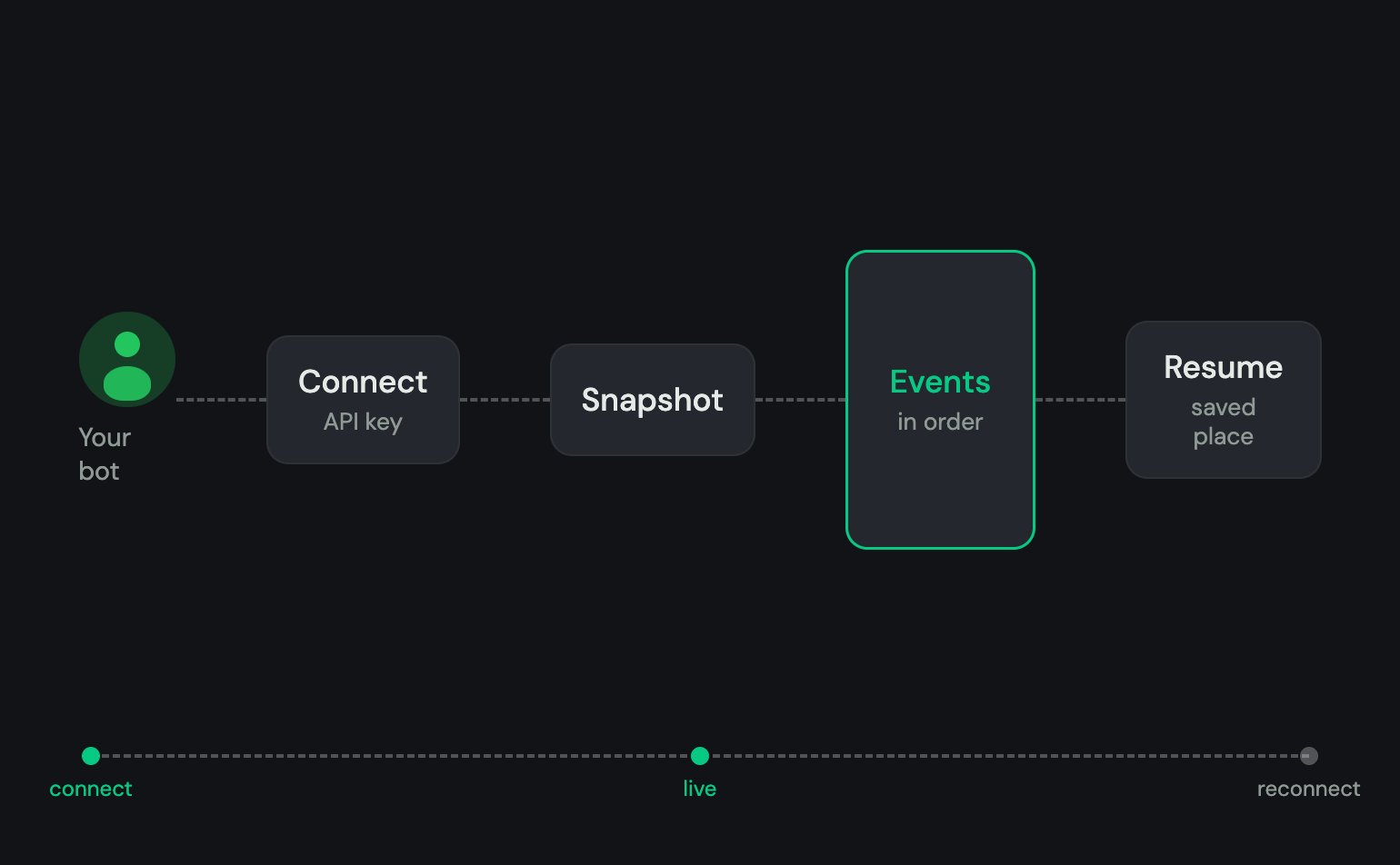
How a connection runs
1
Connect
Open the socket with the
totalis.realtime.v2 subprotocol and your key as
Authorization: Bearer <key> on the upgrade. A browser cannot set that header, so it sends a
second subprotocol, auth.<base64url of the key>, instead.2
Subscribe
Send one
subscribe frame. Include your saved cursor if you have one. The server answers with
subscriptionResponse, whose resume says what follows.3
Load the snapshot
On
SNAPSHOT or RESET, a snapshot frame carries your open RFQs, quotes, acceptances and
operations, and the cursor they match. Replace your local state with it. Balances, positions and
maker capital are not in the snapshot: read them over HTTP now.4
Apply events
Each
event frame is one committed change. Apply it, then save its cursor. Delivery is at
least once, so skip any event whose cursor.sequence is not above the one you saved.5
Resume
After a drop, reconnect and subscribe with your saved cursor. On
REPLAY you get only the
events you missed. Resuming needs the replay:read scope, which the taker scopes do not include,
so add it to the key.heartbeat_interval_ms. WebSocket libraries answer with a
pong on their own. There is no unsubscribe: to change the subscription, open a new connection.
One trade on the socket
The same trade, seen from each side:
An RFQ that reaches
expires_at, and a quote that reaches expiry, send no event. Track both
timestamps yourself.
Position, capital and wallet balance events are pointers. They name what changed and the block it
changed in, not the new state. Read Get position,
Get maker capital or
Get balances when one arrives.
Every event type and payload: Account channel and
Maker channel.
When the server closes
Every close carries an error code as its reason. Itsretry says what to do.
The replay window and the heartbeat interval are on Limits. A cursor
older than the window resumes as
RESET. The stream is the only replay: there is no HTTP event log.
Example
A Node client that resumes, dedupes and reconnects. It uses thews
package, which can set the Authorization header. The
TypeScript SDK wraps all of this in TotalisStream.
Socket or reads
Connection
Every frame, the subscribe response and the resume rules.
Account channel
Every taker event and snapshot class.
Maker channel
Every maker event, snapshot class and the scopes each needs.
Market data
Public reference prices for browsers.